Building premium features without selling victory
Version 1.29.0 extends Valenya to level 55 between Aurélys and Norys, introduces 3v3 Arena and prepares the shop for four platforms. One rule guides the work: nothing that grants power can be bought.
“Premium” can mean a button color, a subscription attached to a meter or a promise written before the content exists. We wanted the reverse: first build a part of Valenya complete enough to deserve offering, then decide when to open its doors.
Work began with a rule that cannot fit inside a shop: anything that grants power must be earned by playing. A subscription can open progression and competition. It provides no better weapon, hidden stat or crafting shortcut. A bought cape says “I like this look.” A cape earned in a raid says “I did this.” The two must never be confused.
From that boundary, we had to build three things together: an adventure cycle from level 46 to 55, real team PvP and a commercial pipeline for Web, Steam, Android and iOS that never lets the client decide what an account owns.
A city once glimpsed becomes a starting point
Aurélys already existed in the main campaign. You entered during a crisis, crossed closed districts, and the story moved on. The new cycle begins after that conclusion. The city reopens some entrances, and facilities seen in an emergency become places to live, work and prepare expeditions.
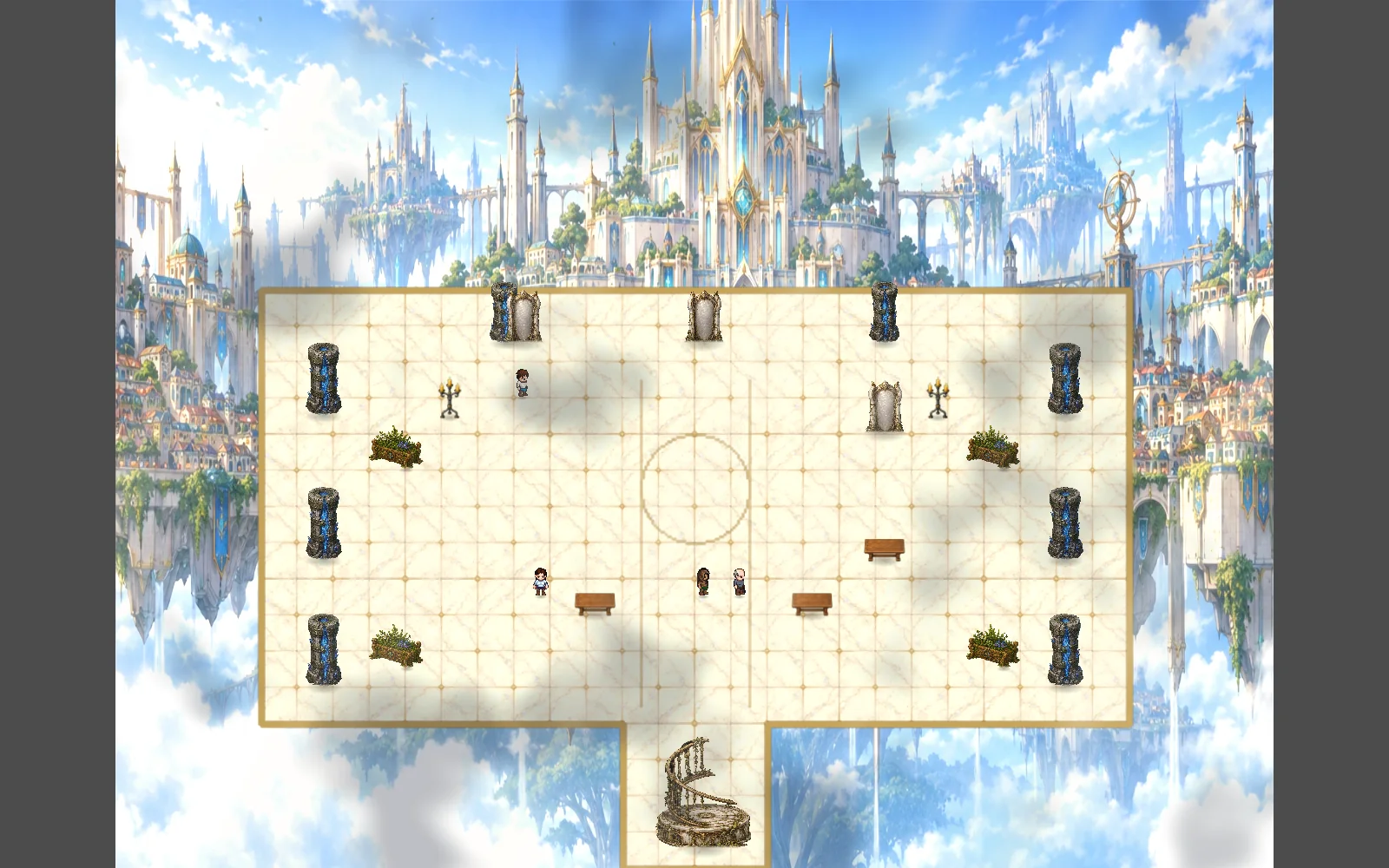
The Pearl Terraces welcome residents, workshops and registers. The Hanging Gardens restart their pumps. Beneath the platform, the Anchorage Underside exposes the chains, brakes and conduits holding the city up. The campaign does not ask players to believe Aurélys is waking up: it has them examine readings, isolate circuits and check every stop.
Then a signal answers.
It comes from Norys, an archipelago the mainland believed lost. The crossing leads to Watchers' Port, the Salt Shoals, the Shroud Islands and the Watch Reefs. Fifteen main quests connect the two shores through to a complete conclusion. We will not detail the discoveries here: the cycle's heart lies in what Norys's inhabitants know, what Aurélys's archives concealed and what the player can finally establish firsthand.
Eleven maps that do not come from the old world
Adding an archipelago could not mean placing three village houses on a repainted beach. The cycle's eleven adventure maps received their own ground, water, organic shorelines, buildings, furniture, vegetation and creatures. A twelfth map hosts the arena. The nine main residents have LPC compositions made for them, using the same animation and equipment rules as the rest of the game.
This cost more than simple reuse, but answers an essential question immediately: when you arrive in Norys, do you feel you have crossed to another shore? Salt-worn stone, dark roofs, jetties, conduits and workshops must answer before any dialogue begins.
The world is more than a campaign backdrop. The Anchorage Underside and the Drowned Relay form two group dungeons. At level 55, The Bells Beneath the Water bring eight adventurers together for the cycle's final expedition. An open Resonance Tide and the Atlas of Crossings offer two repeatable activities without daily quotas: you return because the activity matters, not because a daily box demands ticking.
Progression that feeds the professions
A ten-level cycle needs more than a quest chain and a final chest. Gatherers need new materials, artisans must transform them, and every class must be able to gear up without waiting for a single drop.
The work adds 19 materials, 87 recipes and 74 pieces of equipment across Aurélys and Norys. The six professions continue their progression with pearlescent and maritime resources. Level 46–55 equipment comes from workshops, activities, dungeons and the raid. None is included in the subscription: access opens the playing field; it does not play for you.
Three institutions also continue the story after the campaign. The Free Crews League, the Chancelleries and the Concordat champion different ways to connect the shores. Nine missions let you take a side. This changes dialogue, reputation and capes, never a recipe, stat or activity access. An opinion must not become a bad build.
PvP could not be an enlarged duel
Valenya already had consensual duels. They could pit two players against each other, but used PvE equipment, death and durability. Going from there to two teams of three required far more than a second portrait bar.
The Aurélys Lists are built around one mode: control a central relay. A team scores while holding it and wins at 180 points; otherwise the match ends after eight minutes, with overtime while the relay remains contested. Eliminations award no points. They only create space to retake the objective.
Each class keeps its identity, spells and appearance, but enters with a shared stat budget. Equipment rarity, durability, food, guild bonuses and cosmetics are removed from the calculation. A separate arena loadout lets you choose modules and variants without changing your PvE inventory. Knocked-out characters respawn in the arena: no death fee, no equipment damage.
The queue accepts solo players, duos and trios without breaking parties apart. Reconnection, surrender, abandonment, history, rating, divisions and seasonal rewards each have a server rule. Renown rewards actual objective participation, useful healing and interrupts, rather than a blind damage race.
The tutorial, unranked training, rankings and spectator stands remain free. Spectator mode reconstructs the match in a separate scene with a thirty-second delay. It receives no team chat, private cooldowns or current state hidden behind the delayed image. Watching must not become a cheating tool.
A collection, not a wardrobe of bonuses
All these systems needed a shared home for rewards. The collection belongs to the account: each character can choose owned capes, titles, companions and effects. Banners earned in Norys, Abyssal Blue from the Drowned Relay, institution capes, Renown and seasonal titles keep their provenance. A reward always tells how it was earned.
The Founder Pack follows the same logic. It includes a ceremonial outfit, the First Hour cape, a small Aurélys automaton, the title Witness of the Veil and one month of access. None changes combat. The shop may offer patterned capes, companions, footstep effects or emotes, but never the marks of a completed raid or a won season.
Four shops, one authority
The “buy” button was the most visible and least difficult part of commerce. The real work begins when a browser closes too soon, a phone loses its connection, a store confirms after the game restarts or a refund arrives days later.
Web payments with Stripe, Steam, Google Play and StoreKit 2 have platform-specific flows, but all converge on the server. It alone grants the entitlement, records its origin, restores it after reconnection and revokes it after a refund or expiry. Replaying a request never doubles a purchase. A client-presented price is never accepted as proof. Test purchases remain separate from commercial entitlements and cannot accidentally turn into them when sales open.
This architecture also protects older versions. New messages are additive, capabilities are explicitly advertised, and deploying a server does not raise the minimum build on its own. The new client can fall back against an older server; supported store clients keep connecting as the server receives new components.
Built does not yet mean open
Version 1.29.0 deploys this foundation to the server and desktop client. During PC testing, the test subscription remains available for €0 without a bank card, to explore the cycle and exercise its systems. It will not become a real purchase later. The Founder Pack, commercial sales and the first ranked season stay closed until explicitly activated.
The cycle has been played through locally, all six classes completed the arena tutorial at minimum level, and automated matches exercised recovery, results and delayed spectating. Interfaces were tested on desktop, in simulated mobile layouts and in an Android QA export. Commercial integrations have tests and recovery paths.
Some steps remain that we will not replace with reassuring words: final end-to-end acceptance, visual polish, balance between human players, Google notifications and authentic validation in each store environment. No sale, season or Founder window activates simply because the code exists.
That may be the most important part of this work. Valenya's premium offering must not be a promise to fund content someday. It must begin with real, verified content that has an ending—and the certainty that paying will never buy victory.