Valenya Town reborn: a village, not a backdrop
Valenya Town has been completely rebuilt with a coherent architectural style, organic streets and places that finally tell the story of village life.
Valenya Town is the first place many players learn to know. They return for professions, the market, quests and encounters. Yet its old version still looked like a collection of buildings placed on a large lawn: each element worked, but together they did not really tell the story of a village.
Update 1.18.2 rebuilds this starting point from the ground up. The aim was not simply to replace a few houses. The town needed a shared architectural style, an easily understood geography and spaces that felt inhabited even before the player arrived.
One visual story for the whole village
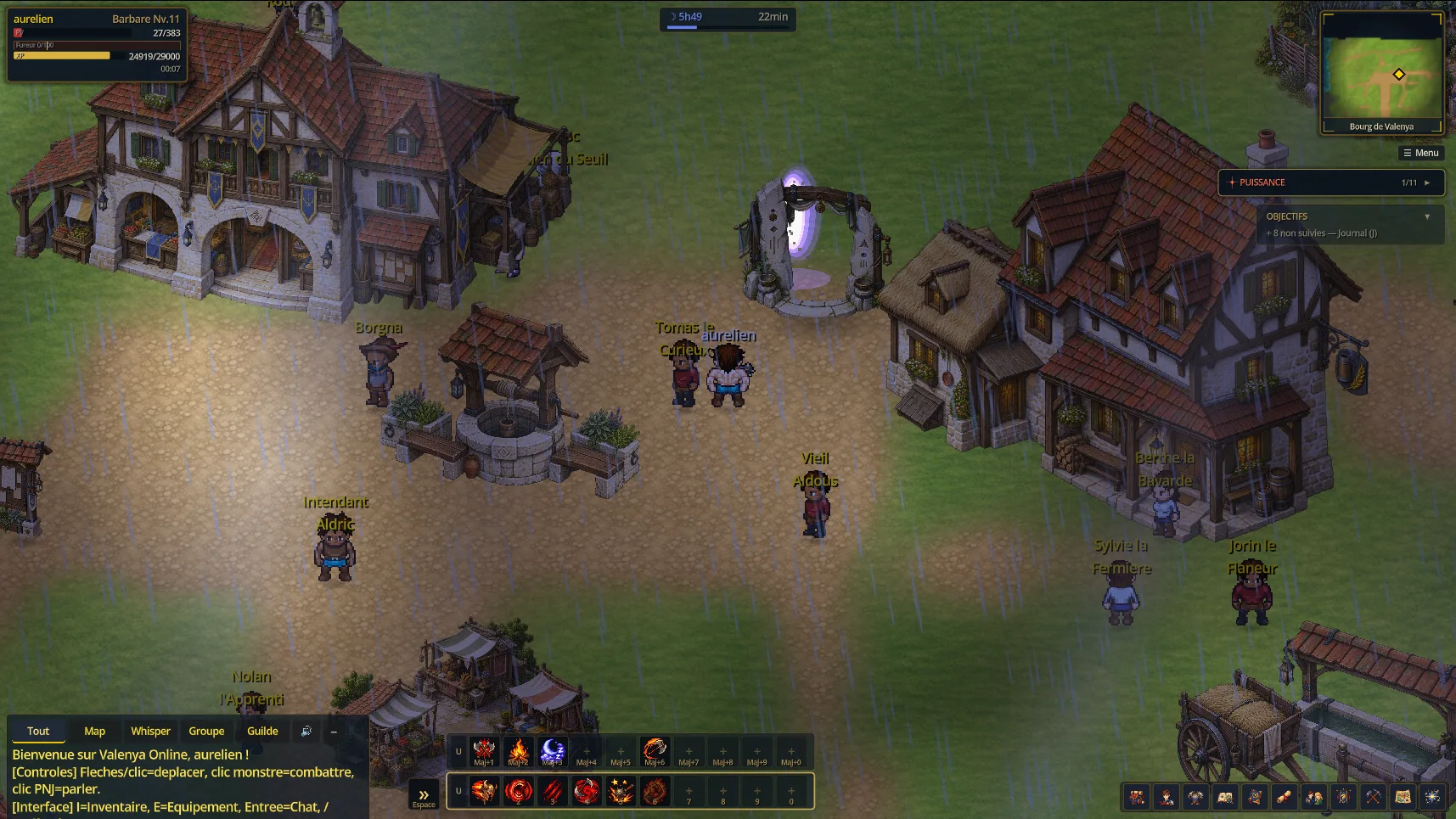
The old town mixed buildings from different art styles. Proportions, materials and viewing angles varied from shop to shop. Individually, the scenery could look good; side by side, the buildings felt less like parts of the same place.
We therefore defined an art direction for the town: warm limestone walls, dark chestnut timber frames, terracotta tiles, golden thatch, blackened ironwork and touches of aged bronze. Buildings vary by age, function and the wealth of their occupants, but they now share the same architectural tradition.
This rule applies to every exterior. The market hall, inn, chapel, forge, bakery, bank, houses and workshops were redesigned together. The well, noticeboard, gate, stalls and even everyday furnishings speak the same visual language.
Streets built around everyday use
A believable village is more than a collection of pretty façades. Its layout must explain how people live there.
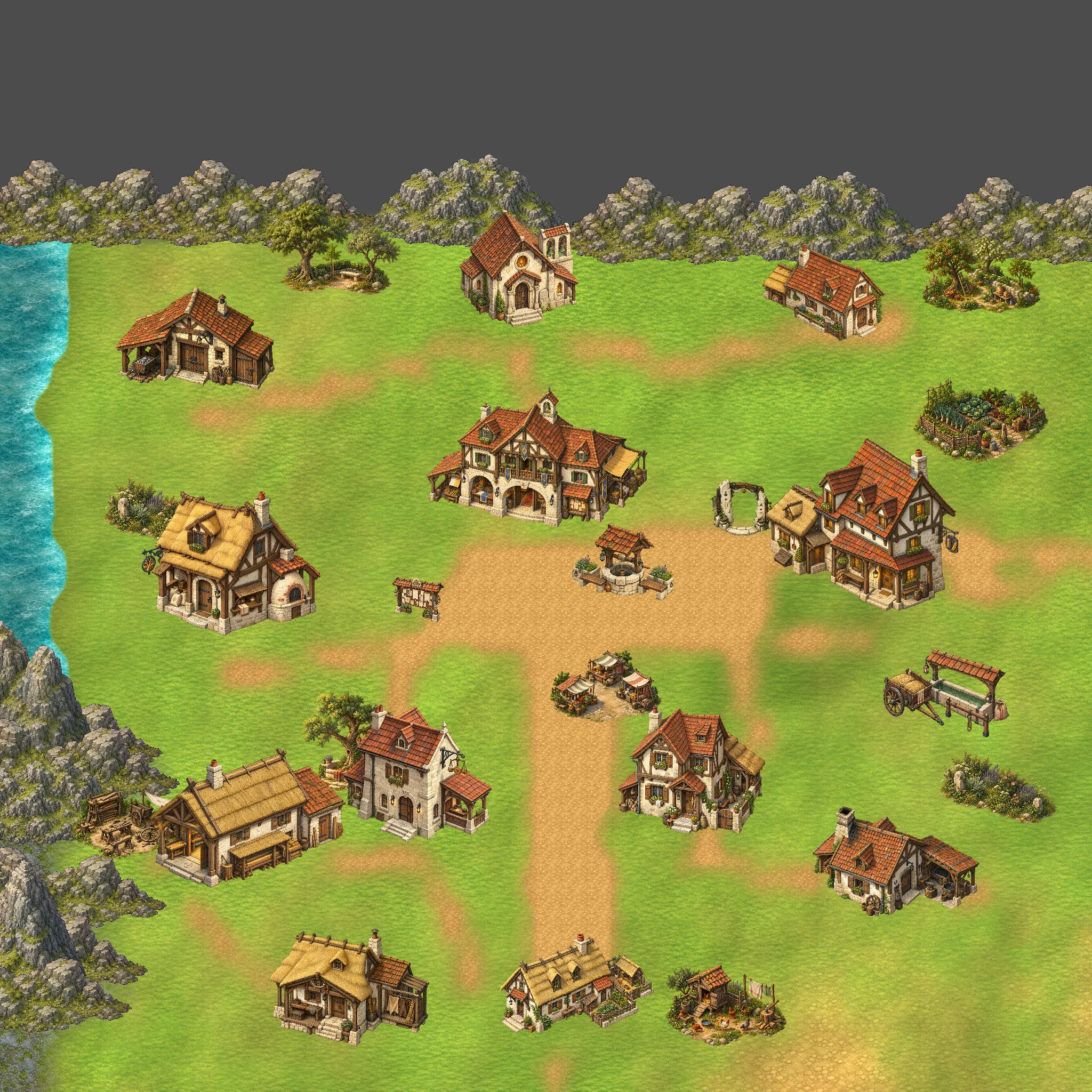
The town now centres on an old trade road that widens into a civic square. The market hall, well and market form its heart. Noisy or bulky activities, such as smithing, carpentry and the miner's depot, occupy the edges. Houses, gardens and orchards find more peace near the fields.
The streets no longer follow a uniform grid. They curve gently, skirt buildings and form small courtyards. Façades face the paths they serve, with buildings seen from the south, east or west. This variety makes travel feel more natural while creating memorable landmarks.
Making everyday life visible
The large wheat field and scattered props have given way to smaller, more precise scenes. An enclosed vegetable garden, poultry yard, communal orchard, beehives, wagon stop and artisan's courtyard now suggest what the inhabitants grow, transport and repair.
Vegetation also contributes to the town plan. Flowering hedges border some lanes, a grove provides a public space and a few trees serve as landmarks. These elements are no longer scattered randomly: they are grouped by purpose and keep the main paths clear.
Eren's memorial has also found its place in this setting. It is treated as a small place of remembrance cared for by the village, rather than an isolated object. It is a quiet but important detail connecting the scenery to Valenya's history.
Rebuilding everything without breaking services
Changing the layout of such a central location involves much more than moving images. Every door must still lead to the right interior. Merchants, profession masters, quest characters and services must remain accessible. The market needs consistent collisions, the teleportation portal must align with its shrine and large buildings must render correctly in front of or behind the character.
Existing interiors have therefore been connected to the new layout. Door detection has been strengthened for differently oriented façades, including when their data arrives from the server. The town changes its silhouette but keeps everything players came there to do.
A more natural world around the town
This reconstruction comes alongside another world project: making water and paths more natural. Rivers now follow the terrain, winding from the highlands to the sea and sometimes feeding lakes with irregular shores. When a river crosses a road, the generator places a coherent crossing instead of arbitrarily overlapping the two routes.
Roads and trails are less straight, too. Their connections between regions remain passable, but they now avoid painting paths over lakes or rivers. This work complements the new compact terrain system : the world is lighter to distribute and now more natural to explore.
An interface redesigned at the same time
The day's work did not stop at the village gates. Ability and status-effect icons were completely redrawn at 64 × 64 pixels with a shared art direction. Their silhouettes and colours remain readable in the action bar, even during busy fights.
Temporary effects show their remaining duration directly on their icons and have more stable tooltips. Main-menu shortcuts become compact pictograms, while their names and keys remain visible on hover. The result takes up less space without hiding information.
What changes for players
The town is still the town: familiar characters, quests, shops and access points remain. But it now has a silhouette, neighbourhoods and a logic you can learn without constantly checking the map.
Above all, this redesign creates a lasting foundation. New events, inhabitants and activities can fit into spaces that already have a purpose and identity. Valenya gains more than new scenery: its first village finally begins to show how its inhabitants live.