Dye Your Tunic, Then Invent the Profession That Makes the Dye
Version 1.24.0 brings equipment dyes and a sixth profession, Alchemist. Both were born the same day, one led to the other, and a full world regeneration ended up breaking three quests. Here are the decisions we made along the way, with figures.
The day's task was supposed to be small: equipment dye, the next row on the vanity roadmap. It ended up producing a profession, five plants, a full world regeneration and three quests to repair. Here is how it happened.
Dye belongs to the slot, not the piece
The first and most consequential decision: you do not dye a cuirass, you dye your chest slot. Color lives on the equipment slot and survives item changes. The cuirass replaced at the next level keeps the shade chosen at the previous one. Otherwise, every equipment upgrade would cost a vial, and players would eventually stop dyeing.
Each slot has two tones. The light tone takes the layer's highlights, the dark tone its shadows, and the blend follows the original drawing's luminance. It uses the same principle as last week's heraldic cape: modulating color instead of replacing pixels, so a fold stays a fold. The catalog has eight craftable vials: madder, woad, saffron, sage, tan, ash, chalk and ochre. One vial per applied tone; “None” washes it off for free.
What travels over the network to other players is colors, never codes. A client seeing a stranger receives three numbers per slot and draws them.
Rare dyes were rejected once
The design document planned four raid-earned rare shades: ink black, bone white, aged gold and purple. They were coded, rendered on a sheet of twelve characters and rejected in one sentence: “They look the same as the basic ones.” On the sheet, ink black beside dark ash is just another color. Another color is not a top-tier reward.
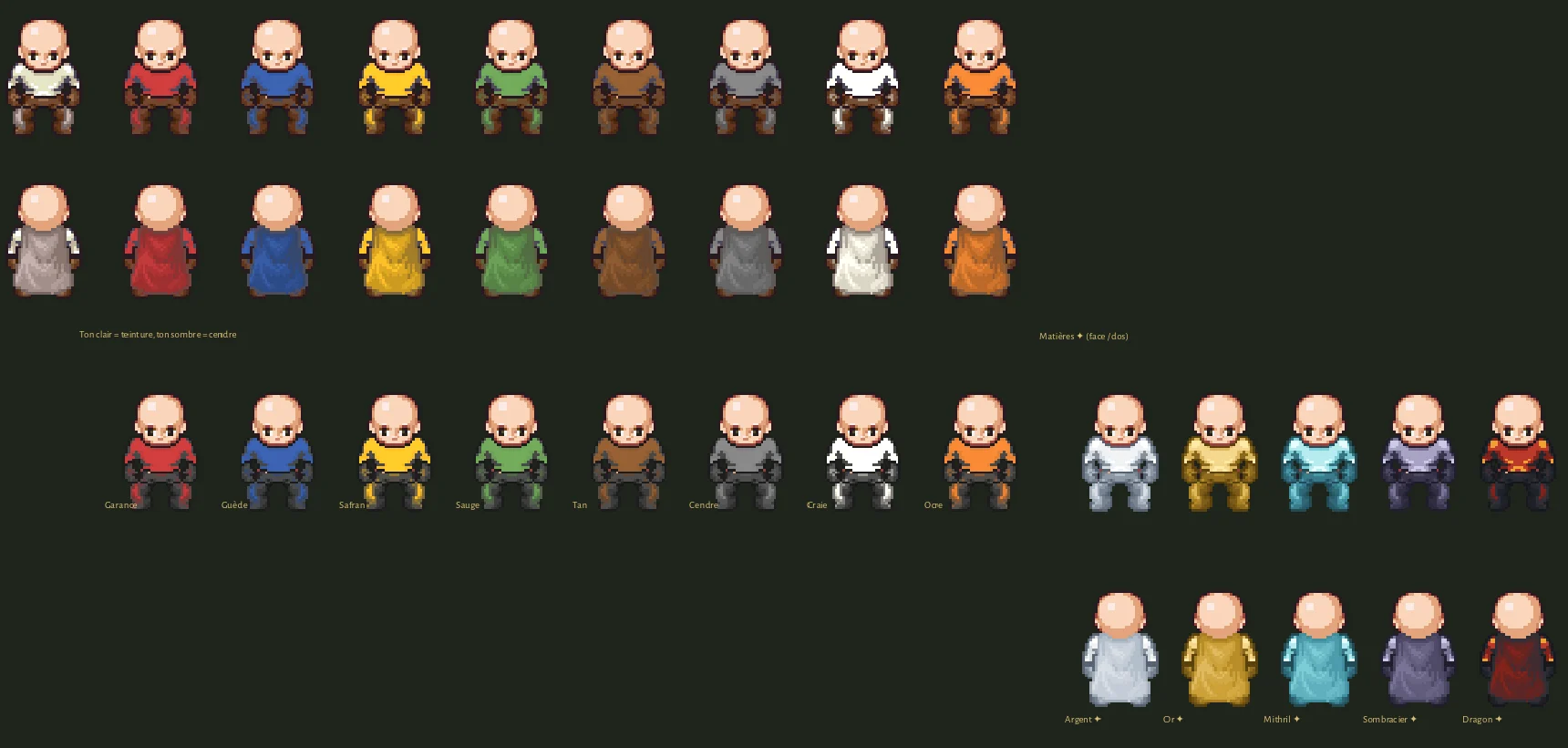
The shipped version is different in kind. The five rare options are materials : silver, gold, mithril, darksteel and dragon. They use exactly the color ramps already used to draw crafted equipment at those tiers, from the script stitching the sheets. A tunic dyed “mithril” has the material of a mithril piece, reflections and shadows included, because it is literally the same ramp. A material dresses the entire piece, both tones together. It unlocks by completing all three raids at a given difficulty (silver on Heroic, dragon on Insane) and is not an item: it cannot be sold or traded.
Something learned about Insane along the way: each tier doubles monster power. Insane is thirty-two times Normal, with eight minutes before enrage. Nobody has a measurement proving it possible with current equipment. Dragon dye exists; it may go unworn for a long time.
The missing profession
Vials had been assigned to cooks and trappers for lack of a better home. While looking for ingredients, we noticed the world had thirteen different rock nodes and two plant nodes. Ores have a geography by ring, from starting copper to Origin at the fringes. Plants have none: the same bush at level 1 and at level
- And no potion can be crafted: they only come from chests and quests.
That gave birth to the sixth profession. The Alchemist harvests five plants, one per region, each with a rare find at three percent: stump mushrooms in grasslands and forests, peat flowers in marshes, dune bulbs in the desert, frost lichen in tundra and glowing moss in deep caves. It makes health and mana potions, an antidote and eight elixirs, and takes over the eight dye vials as early-level recipes.
A decision about potions
Before writing a single recipe, we had to settle a question that changes the entire profession: should potions keep a shared cooldown? Today, drinking one locks all potions for fifteen seconds.
Without that lock, a potion becomes unlimited instant healing as long as you have stock. Bosses must then assume everyone drinks continuously, and a group without an alchemist cannot succeed. The profession becomes mandatory, the healer's role fades, and the Auction House fills with cut-price potions. With the lock, a potion is an emergency button once per phase, and healing remains the domain of spells.
The lock stays. The consequence for the profession is direct: a potion's value cannot come from consumption volume, so it comes from variety. Elixirs are the real outlet. An elixir grants +2 to an attribute for twenty minutes, or +4 for thirty minutes with a master elixir consuming a rare find. It stacks with a meal, never another elixir. You drink it before a run, not during one.
Regenerate the world, then repair what breaks
Plants exist only if maps contain them, and maps are generated. We therefore had to regenerate all 167 world maps, with their images. Result: 508 mushrooms, 151 bulbs, 76 lichens, 59 mosses and 21 peat flowers.
Regeneration is never free. Adding a resource type shifts the random draws for everything after it on the map, including monsters. Three story quests felt it, and campaign tests caught them before players did. A marsh quest required four revenants on a map now generating only three. Elias Merel, waiting outside the village hall, had moved four tiles during the pass that takes characters out of roof shadows. And the woodland hamlet ended up with duplicates of all eight village residents because generated identifiers had shifted by one.
All three repairs follow the same pattern: pin anything that must not depend on randomness in the saga patch file. Four revenants around the street plaque, Elias on his exact tile, and both identifier sets to remove. The next regeneration will preserve them.
Still to do for Alchemist: the Herbalist specialization and percentage-based health potions above level 20, because a 150-point potion is worthless at level 40. Dyeing, meanwhile, starts tonight: right-click your chest slot.