Choose your path before taking a step
Players were stopping at level 5. Right where the game finally gave them a class, then sent them back to level 1. Version 1.26.0 moves class selection to character creation, merges the two experience curves and shifts all content by five levels. The story of a redesign affecting 805 items, 108 monsters, 57 quests and 127 chests, with brighter menus and a proper gate to the Shroud Heathlands along the way.
There was a comment in the server code, written in late August, that said roughly this: telemetry shows players disconnecting fifteen minutes after choosing a class, just long enough to realize that level 2 costs more than the entire tutorial.
We had treated the symptom at the time by compressing the start of the class progression curve. Level 2 dropped to 500 experience points: five wolves. Players kept stopping at level 5.
The cost was not the problem
Here is how a character began until this week. They arrived without a class, as a Wanderer, and leveled up to the cap of 5. They then visited the village steward and swore their Oath. The server executed these two lines:
player.setLevel(1); player.setXp(0);Attributes stayed; we had fixed that a little earlier. The level, however, went back to 1. The player had just chosen a class, finally had a sense of what they were playing, and the game told them they were starting over.
That was the moment telemetry was catching. A wall of meaning, rather than difficulty.
Choose first
The new version asks the question at the right time: at the very beginning. You choose your Path when creating your character, before even giving them a name.
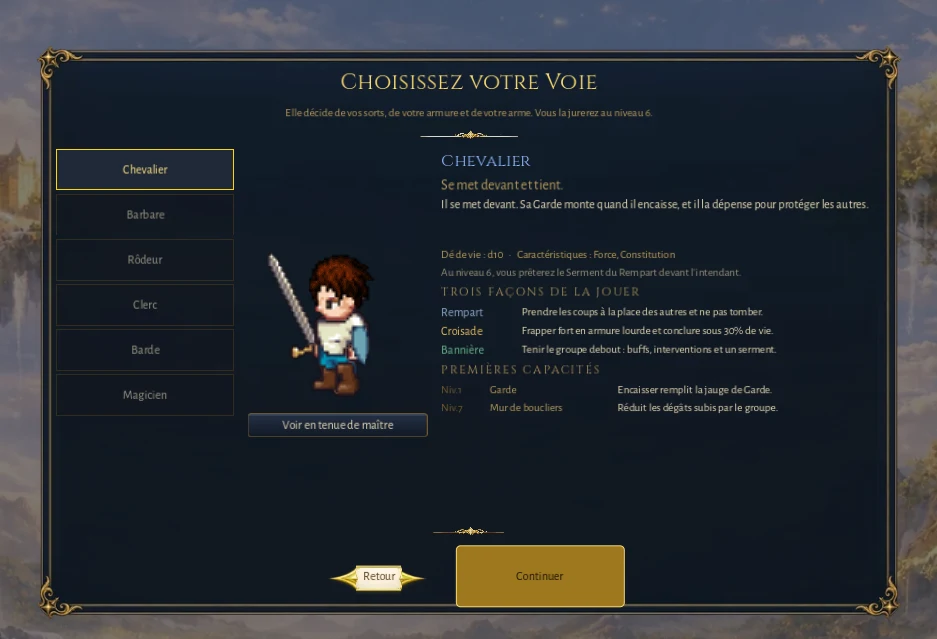
Character creation now has two stages: Path, then identity. We tried putting everything on one screen: six classes, the character sheet, the silhouette, the name, the face and the twenty-seven attribute points. It buried precisely what we wanted to highlight.
The panel on the right contains no text written specially for it. The description, hit die and abilities come from the server, just as they do in game. The three ways of playing each class are those already written for the Skills panel. We have followed one rule for a long time: a rule description lives in one place, or the two versions eventually contradict each other.
The button beneath the silhouette switches between day-one clothing and a master's outfit. On the left, what you will be holding in ten minutes. On the right, what you become at the end of the open world, wearing the final set in your armor family. The button gives no level, deliberately: a number means nothing to someone who has not played yet, and would become outdated the next time the cap moved.
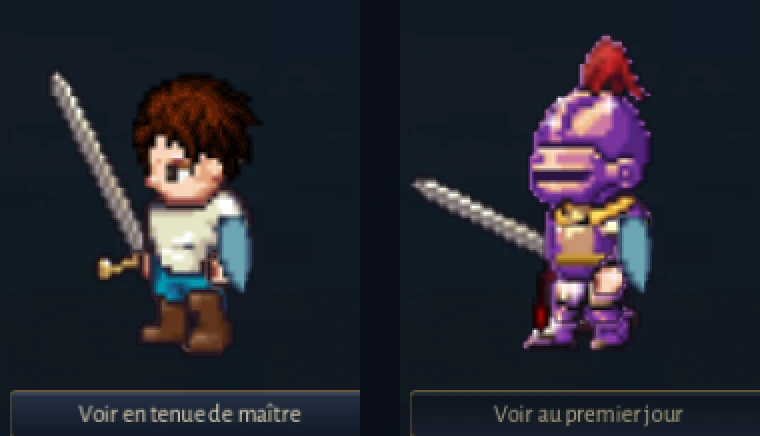
This is no special rendering: it is the game's actual sprite component, the one that displays other players, with mock equipment passed in. It took two hours to connect and immediately exposed a bug that had been around for months. The Ranger's longbow, their starting weapon, points to a sprite sheet that does not exist. Nobody had noticed because the weapon simply stays invisible in their hand instead of showing an error.
It also revealed a flaw we had just introduced. The Bard and Wizard wore exactly the same robe: we had inferred their armor from the rules governing who can wear what, instead of following the sets actually drawn. The Bard wears leather, like the Barbarian, with a hat and cloak of their own. A choice screen where two options look identical is useless: a test now compares the six outfits piece by piece and rejects any twin Paths.

What becomes of the Oath
Removing the quest would have been simplest. We did not: the six Oaths (Stone, Trail, Dawn, Echo, Ember and Bulwark) have been part of the lore from the start, and Steward Aldric is one of the few characters everyone meets.
The Oath therefore becomes a rite at level 6. You already have your Path. You visit the steward to swear it aloud and enter it in the register. The word “Wanderer” simply changes meaning: it is no longer a class, but a status. Someone who has not yet sworn. All the tutorial text stays true without changing a line.
The class weapon changes hands along the way. The Old Hermit gives it to you at the very start of the tutorial, instead of the wooden staff he used to give everyone. The Knight starts with a sword and shield, the Wizard with a staff, the Bard with a lute. The tutorial becomes a little easier. Since an automated playtest died there twice in a row, we will take it.
Joining two curves into one
The underlying problem remained: two overlapping journeys. A level 3 Wanderer and a level 3 Knight were different things, and the latter was much stronger.
Without the reset, there is just one curve. The first five levels keep the tutorial's pace. Going from 5 to 6 costs 400 points, a new rung replacing the Oath's free transition. From 6 onward, we use the old class curve unchanged, shifted up by five.
This shift is the least spectacular part of the work and by far the longest. An old class level 12 becomes level 17, and everything has to follow: the level requirements of 57 quests, the five rows of every spell tree, the ability tiers of all six classes, the required levels of 635 items out of 805, all 99 monsters with a level, the three raids, the free cap moving from 40 to 45, and the server cap from 100 to 105. Forget a single table and you get a subtly broken game, where a quest opens three levels too early or a spell tree refuses a point you paid for.
Two safeguards did their job. The spell tree refuses to start if a tier matches no declared gate: the server will not boot, so no node can be forgotten. And the test suite flagged every value still on the old scale, one by one, until none remained.
One did remain, though, and no test knew about it. World chests have a level, written into the map when it is generated. We had decided to leave it alone, thinking it was only used to choose a loot table. That was half wrong: it also selects the crafting plans a chest can contain, and those plans' required levels had just risen by five along with the other items. A level 9 chest was looking for level 9 plans that had become level 14 plans. For one evening of testing, every chest handed out plans five levels below its area. All 127 map chests now follow the monsters' shift, and a test compares the two scales.
The first quarry
One detail nearly went unnoticed. Shifting monsters up five levels along with everything else left a player finishing the tutorial at level 2 or 3 facing level 7 boars and level 9 wolves. On paper, nothing had changed because everything moved together. In practice, it had: the old world used every area twice, once as a Wanderer and once with a class, thanks to the reset. Without the reset, that double use disappears.
The bottom of the ramp was therefore tightened by hand, in two passes. The first left wolves at level 8 outside the village, which looks wrong when you arrive at level 3, even if the experience window makes them killable. Players judge the displayed number, not the formula. The second pass puts boars and pigmen at level 4, the boarman at level 5, and wolves and bandits at level 6. The first quarry stays one to three levels above someone just through the gate, and normal progression resumes afterward. That is the kind of correction no script finds for you.
This handmade ramp has a side effect on the world generator, which chooses an area's creatures by their level and distance from the village. A uniform shift can be offset with one setting. A ramp cannot: wherever the curve starts, a full regeneration would have put the wrong creatures somewhere, two levels too low out in the wilds or wolves in the village. The generator therefore keeps its old scale and converts the bestiary on input. The world it generates tomorrow will match yesterday's, creature for creature.
And existing characters
They lose nothing. Characters who already had a class gain five levels, five attribute points and one skill point, exactly compensating for the extra rung on the new scale. Their current experience remains valid down to the last point, because their current level costs the same on both sides of the change.
Characters who remained Wanderers choose their Path when they click Play.
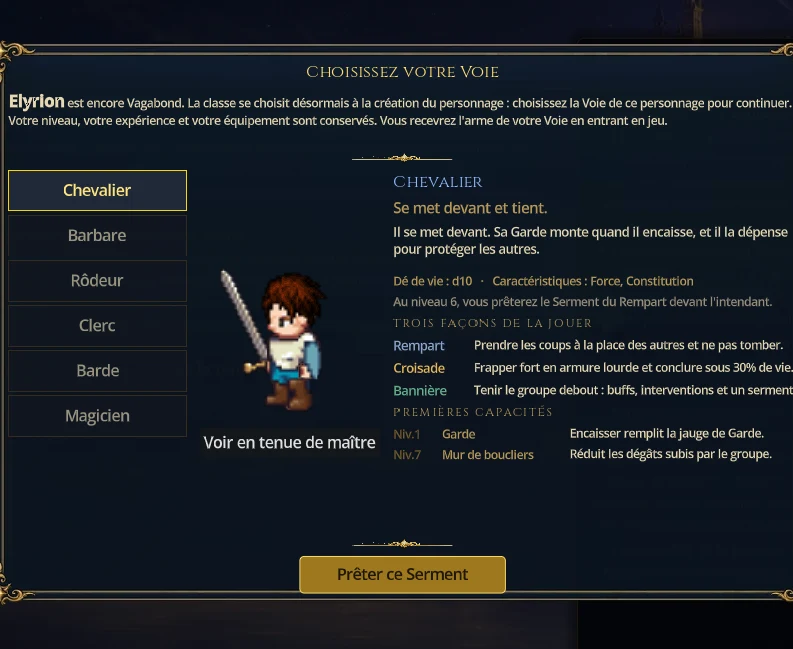
Same screen, same character sheet, same silhouettes. Level, experience and equipment are kept, and the Path weapon is awarded on entering the game. There is no Cancel button: the server refuses to let a character without a class enter, so an exit would lead nowhere.
Menus that light up
While looking at the opening experience, another detail surfaced. The menu bar in the bottom right has eleven gold buttons. A red badge already announces new activity, but it is hard to spot among eleven gold frames, and a new player does not know which ones are worth opening.

A gold glow now pulses around a button for two reasons. The menu has never been opened. Or a badge has just appeared: the hundredth quest ready to turn in lights up the journal just like the first, even for a familiar menu. Clicking turns off the glow.
The badge follows the task itself. It stays until skill points are spent or the quest is turned in; looking at your journal no longer clears it. Previously, opening the panel reset the counter, and a simple refresh could inflate it. It now counts the actual state.
Two pitfalls appeared along the way. HUD panels start visible and then hide during startup; that flurry marked all eight menus as visited before the player saw the screen. And the first two-pixel outline disappeared into an interface already full of gold borders. Hence the glow around the frame instead of a line.
A gate for the Shroud Heathlands
The entrance to the Shroud Heathlands, the cursed region northeast of the Iron Heathlands, was just a three-tile iron fence across the portal's mouth. Nothing hinted at what lay beyond.
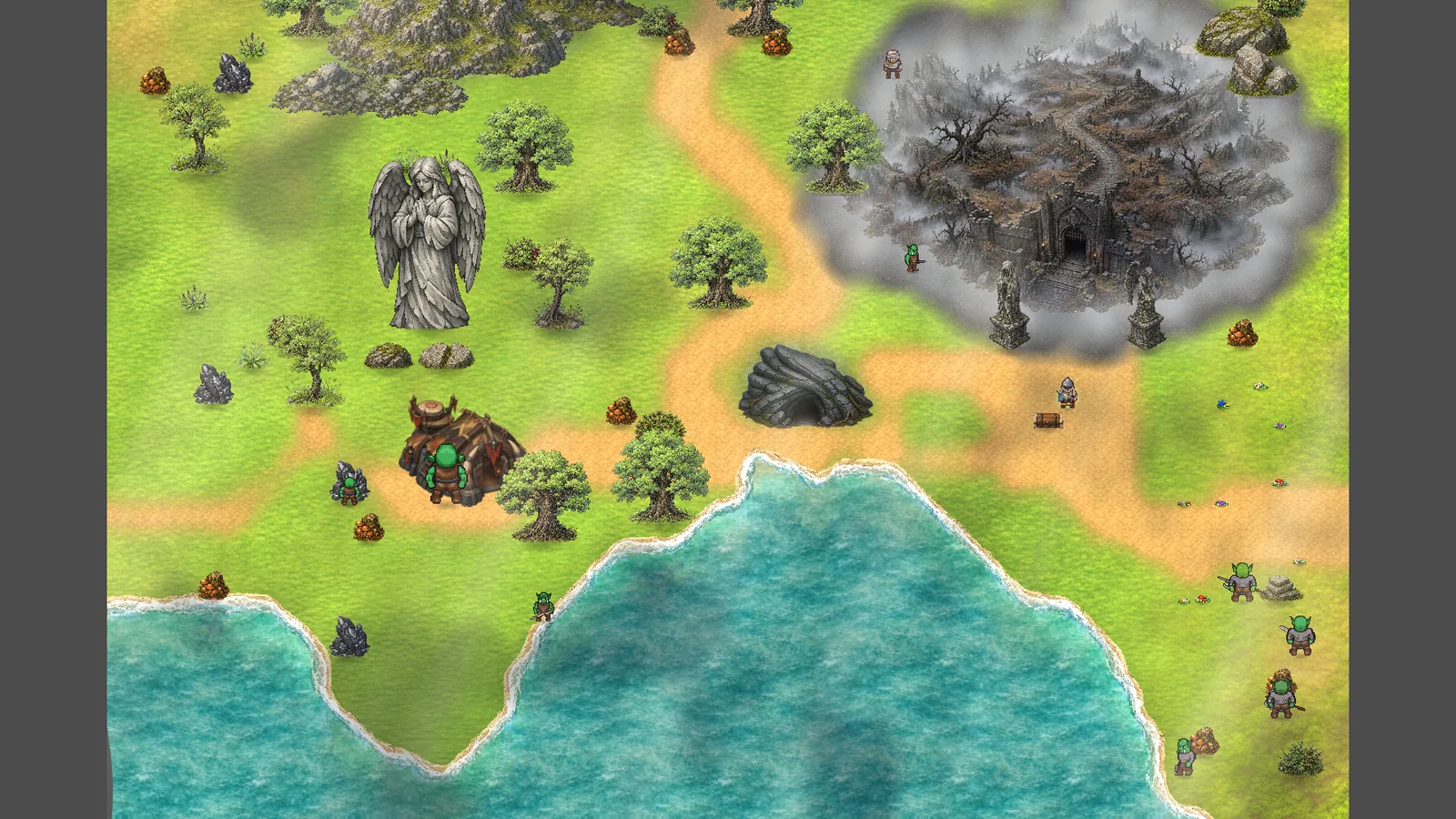
It follows the approach of the Monastery of the Eighth Bell: terrain scenery viewed from above, 23 tiles by 15, closing off the corner of the moor and readable at a glance. A paved approach, a portcullis gate, a rising moor of graves, and the black castle deep in the mist. The path is the only way through, and the region's name appears in a banner as you approach.
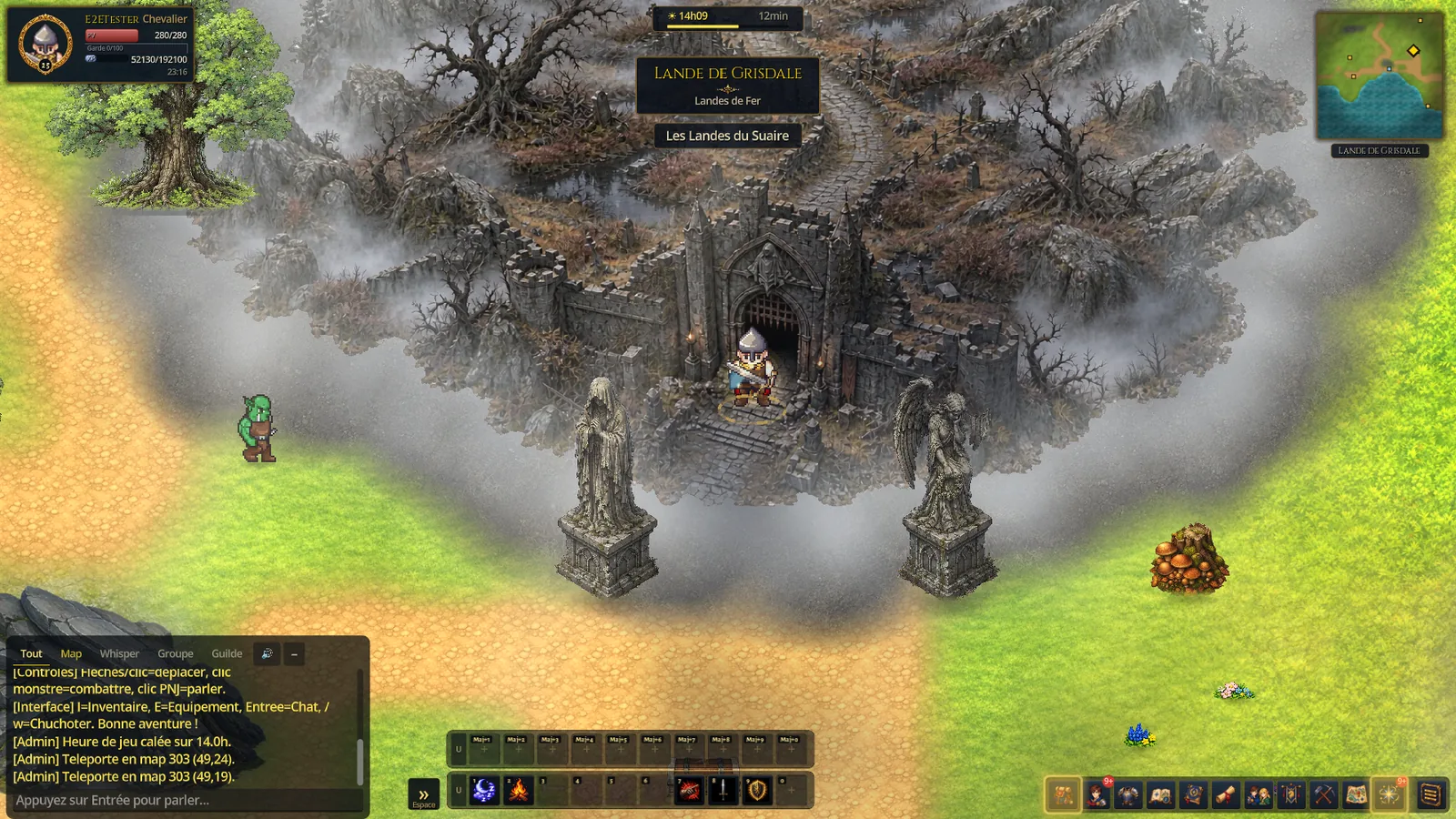
Scenery this large poses two problems a tree does not. First, depth sorting: placed as one block, the terrain would swallow the player as soon as they walked up the path. It is therefore cut into one-tile slices, each anchored to its row, with the path slices drawn beneath the player. Second, color. A gray moor cut sharply against the green grass of the Iron Heathlands looks pasted on. A layer of mist straddles the edge, strongest at the silhouette and fading both inward and outward. The edge stops being a line. Collision is calculated from the solid drawing: the mist blocks nothing.
Orgarde's camp, an orc hideout, was five tiles from the new gate. Two monuments side by side, with conflicting perspectives. It moves to the other end of the moor, with its orcs and chief. The map saga counts its occupants and references its identifier, so it could not simply disappear. Chests covered by the monument were moved out from underneath instead of deleted: a chest is loot a player expects.
The final checks found two more silhouettes in the fog: a chest pushed onto the rocks and the Survivor who gives the region's quest. They now wait in the clearing. Beneath the mist, dead ground spills over in an uneven fringe four and a half tiles wide. The gate is no longer a gray image on a green meadow; the moor gradually takes over.
Eight little companions in your footsteps
This version also adds pets. Eight companions, two families, and one simple rule: they give no stats. A companion is a presence, not a mandatory build slot.
The four jellies are earned during Sunday evenings. The first is awarded for attending, with no boss kill required, precisely so newcomers welcomed by these evenings are not excluded. It then grows after 5, 15 and 30 hours actually spent outside at your side. Putting it away stops the clock. The four Lumelins accompany raid milestones already recorded in achievements.
Their movement does not simulate a second player. The client keeps a trail of the owner's footsteps, and the pet follows it a little behind. It never overtakes, cuts through a house or burdens the server loop. The collection also shows locked companions and explains how to meet them.
The first evening was due on August 30. Pets had not yet been deployed that night, so the server could not award anything. We reconstructed attendance from dated database records—quests, crafting, combat and raids—between 7 p.m. and 11 p.m. Eleven characters received their jelly retroactively, without rewarding those who had merely logged in earlier that day.
Doing, not reading
The tutorial had already lost half its words. The rest of the game had not followed. You could meet Elias for the first time and immediately hear a story about fragments without knowing who he was, what the requested object was or why he wanted it.
We revised every quest using the same rule as the early Pokémon games: one sentence of context, one clear action, then a direction. Quest givers introduce themselves when needed, objects are named before they are requested, and each step answers “what?” and “why?” without turning dialogue into a novel. A safeguard now measures length and rejects returning monologues.
Tutorial cooking illustrates the change. It no longer gives you three instructions to memorize. The tracker asks for a log. Once you pick it up, it asks you to place the fire. Once the fire is down, it asks you to cook the meat. One action, one response. The first cooking attempt can no longer burn, and the axe you receive goes straight into the tool pouch.
Campfires received the same attention. They find a free tile instead of covering the Hermit, and lighting another puts out the previous one. Waiting five minutes because you walked twenty meters taught nobody anything.
The same correction applies to your first profession. Roderic now gives you a voucher at the end of “Two Logs, One Trade”; Haldor exchanges it for your chosen tool. The empty pouch, recipe and craftspeople all explain where to find the next one. The wooden handle and iron ingot no longer require the very tool they are used to make.
Finally, waiting for a monster is not a quest step. The Reanimated Repairer returns after fifteen seconds instead of five minutes. Boars return after twenty seconds, and the quest asks for five because the map has five. Aldric stops asking someone who is already level 6 and has sworn their Oath to return at level 6.
An interface everyone can size to fit
Windows recently became movable; now they are resizable. Dragging an edge gives the content more room. Dragging the bottom-right corner scales the whole panel, text and slots included. Inventories, banks, trades and chests add columns when space allows, while lists and the map use the extra height. Size is remembered alongside position between sessions.
For laptop screens, a global scale option completes the system. Auto mode compensates for density and resolution so text designed at thirteen pixels does not become a footnote on a system-scaled 1080p screen.
The Chronicle needs to be visible without adjustments. Its exclamation mark is larger, animated and surrounded by a blue glow. A quest ready to turn in takes priority over a new offer, and menu buttons with something to show stay lit until the task is done.
We also made interactions more predictable: clicking a window brings it to the front, tooltips stay above shops, opening a trade opens your bag, and dropping an item onto the trade adds it instead of offering to discard it. In the Auction House, long names truncate cleanly and a real “Buy” button replaces the mysteriously clickable row.
Combat beneath the character sheet
The Bulwark had the right silhouette and the wrong arithmetic. At equal levels, it dealt roughly 6% of a Mage's damage. Once Challenge's lock ended, no reasonable threat multiplier could keep it from losing the monster. A shield now grants a permanent tank stance with tenfold threat. Armor also contributes to melee attacks, and even more to Shield Bash. It remains a tank, but one the group no longer has to wait for between enemies.
Support spell ranks had another invisible flaw: they multiplied a “power” those spells did not have. Investing a point in High Guard, Fortress or Challenge changed nothing. Ranks now extend their duration, the description says so, and damage reductions approach their cap without displaying impossible numbers such as 145%. Challenge also taunts enemies grouped around its target.
The Mage, conversely, emptied its mana in seventeen seconds and finished the boss with its staff. Mana now regenerates during combat at 2% of the pool per second. Fire Bolt drops from 1.30 to 1.10 to offset the added burst: the result is less all-or-nothing, rather than a free increase to peak damage.
Two Mages could also erase each other's burns, just as two bleeds could steal each other's source. Burns and bleeds are now tracked per caster, like the Ranger's poison. The build simulator follows the same rule, stops damage at the target's death and no longer credits a full duration to five effects cast in parallel. The guide's figures are less flattering in some cases; above all, they are accurate.
The long list of small frustrations
A major release is about more than systems. It is also about seconds given back to players:
- an item at zero durability stays broken when moved through the bag, bank or trade;
- tools can be repaired directly from their pouch;
- the world map refreshes party members' positions even when they change region;
- joining a party properly removes you from the previous one, with no phantom members or lingering shared experience;
- duels wait for a click on the opponent and obey movement orders instead of playing themselves;
- after losing focus, twenty thousand delayed packets are spread over several frames instead of freezing the client for nearly five seconds;
- equipment disappears behind buildings with the body, and the chest piece finally follows the sitting pose;
- an inn's transparent margins no longer intercept a click meant for a nearby NPC;
- rugs and ambient animals no longer form invisible walls;
- nighttime lights are selected based on the camera and no longer flicker with every step;
- beds, candelabras and placed objects return to a scale consistent with characters and tables;
- interior generation knows furniture footprints and no longer puts a chest inside a chandelier.
Campaign emails also gained a signed, one-click unsubscribe link honored by all future sends. It is not a game mechanic, but respect for players starts before the login screen.
What we will know in two weeks
The onboarding funnel has been instrumented since August. We can measure how many players create a character, reach level 3 and return the next day. The question this version addresses will therefore be answered with figures rather than impressions.
What is already certain fits into one sentence: nobody spends fifteen minutes playing a character without knowing what they will become.