Recognizing a Player from a Hundred Paces
Until this week, a crafted cuirass and one dropped by a monster were the same drawing recolored. Version 1.25.0 redesigns every crafted outfit, all six Monastery sets and the Count's Regalia, and gives the Lower City raid its loot. How we built it with a sprite generator, a stitching script and plenty of rejected designs.
The game had 453 craftable equipment pieces across 285 sprite sheets. Almost none were shared with monster loot. Yet a player in artisan-forged steel harness and one wearing harness looted from a skeleton were indistinguishable: same shapes, different colors. Worse, a Cleric and a Knight in plate looked like the same person. Crafting, the heart of the game's economy, was invisible.
The body shows the tier, the head shows the class
Our first idea was a signature for each armor family. That was not enough: Knights and Clerics wear plate, Rangers wear mail, and Barbarians, Bards and Wizards wear leather or cloth. A family signature leaves two or three classes in the same costume.
The chosen rule is hybrid. The body (chest, hands, legs, feet) carries the family and tier signature. The head and the cape carry the class. It is still the same item for everyone: a Steel Helm remains a Steel Helm, but on a Knight it becomes an armet with a red plume, and on a Cleric a barbute beneath a halo. The server sends one code; the client chooses the sheet according to the wearer's Oath. No recipe changed and no restriction was added.
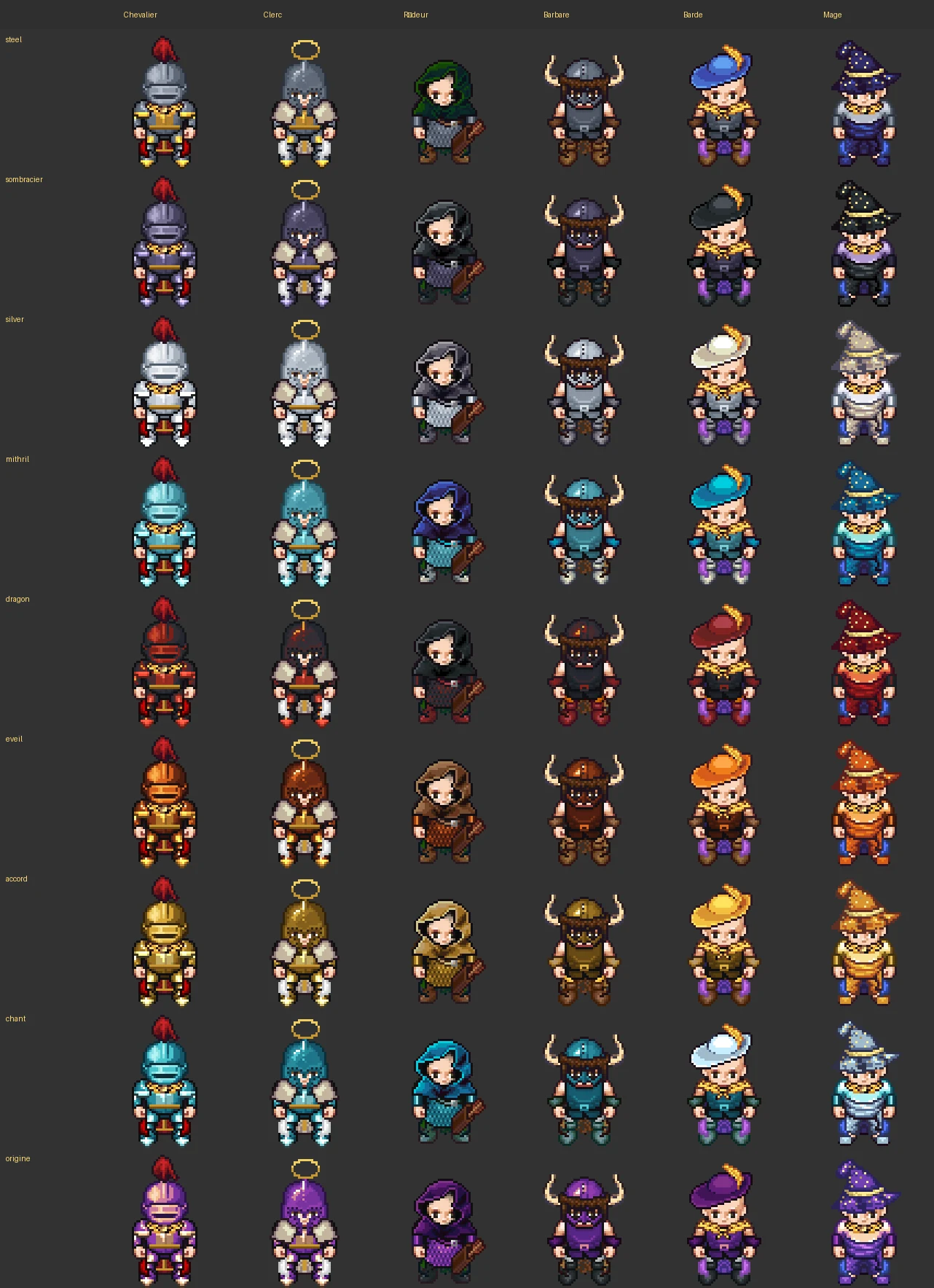
Nine tiers, from steel to Origin. For each, metal follows the material's color ramp, while cloth, leather and fur receive handpicked colors. Hats too: the Bard's hat and Ranger's hood change shade with every tier. The Barbarian's helmet needed special treatment because a metal ramp applied to a fur-edged helmet turned it into a gray mask: only the metal is recolored, while fur and horns remain unchanged.
The Wanderer has no outfit. That class stops at level 5 before the Oath, and steel starts at level 8. We had designed its traveling hat and backpack before doing the math.
How to make 828 sheets without an artist
The game uses LPC sprites: an 832 × 1856-pixel sheet, 29 rows of 64-pixel cells, one row per animation and direction. Redoing that by hand for every piece, tier and sex was not an option.
We first tried pixel retouching: drawing trim or a crest on the four idle frames in Aseprite, then propagating that difference through all 29 rows using a script tracking the piece's bounding box in each cell. It works, it is pixel-perfect, and it was too timid. At 64 pixels, nobody sees brass trim on a helmet.
The answer lay in the LPC character generator itself: 26 helmets, nine head accessories (crests, plumes, horns, wings), five shoulder-pad types, tabards, mantles and torn capes. A script bakes them into the piece's sheet, applies the tier's metal ramp, and that is it. The first Knight attempt with an armet and a proper plume settled the question in one image.
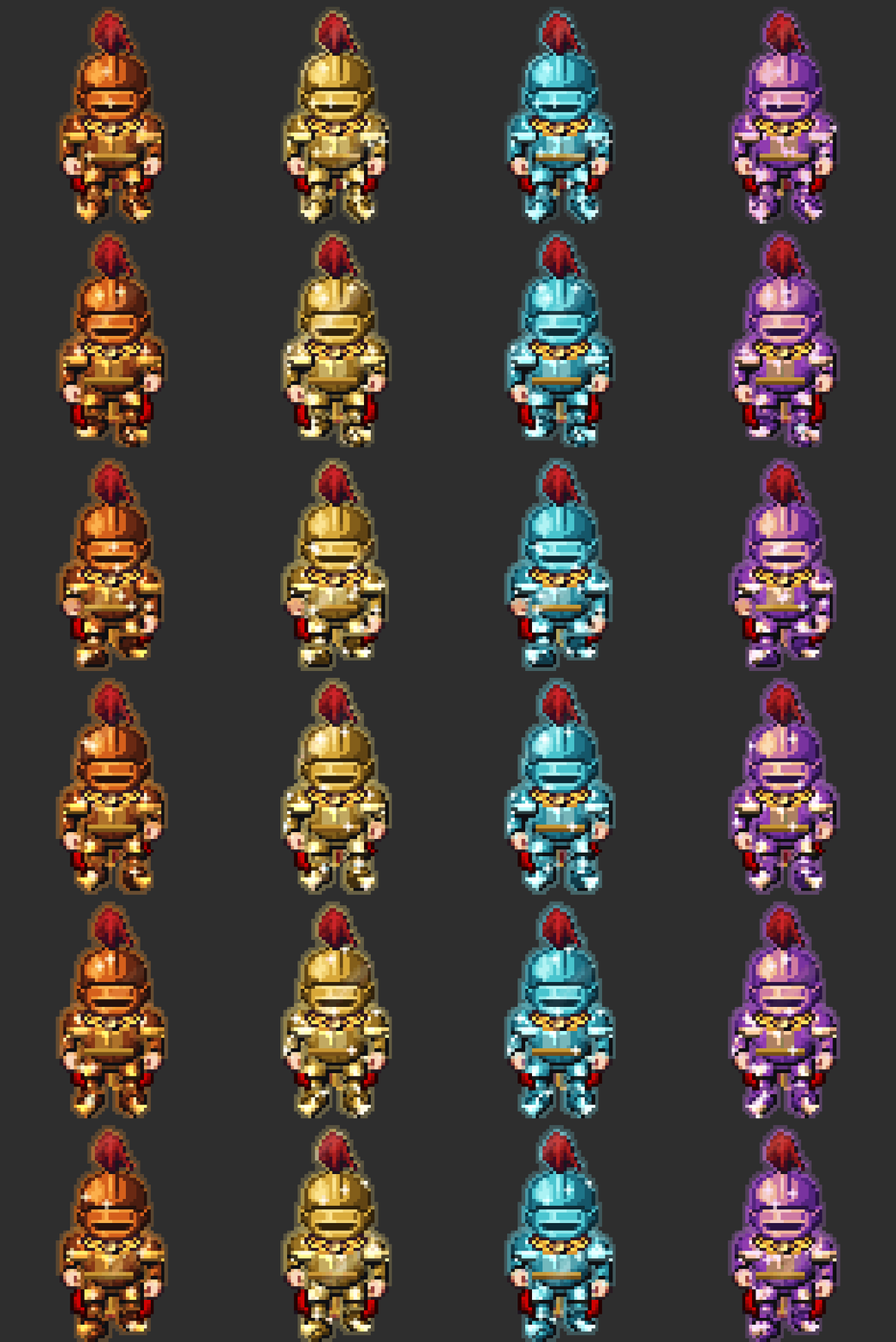
Above dragon tier, sheets also receive effects baked into the pixels: a luminous edge, a reflection shifting from frame to frame so it slides over metal as the character walks, and sparks whose positions depend on the frame. No shader; everything is in the image.

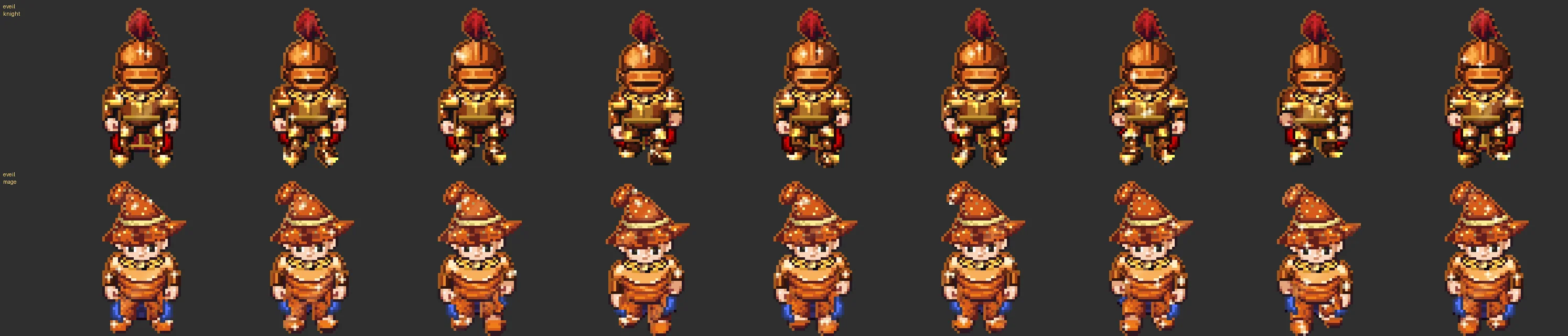
We also prototyped a pulsing shader aura, a breathing halo around the piece. It is ready and set aside. It will become an unlockable reward.
Treasures of the Bell
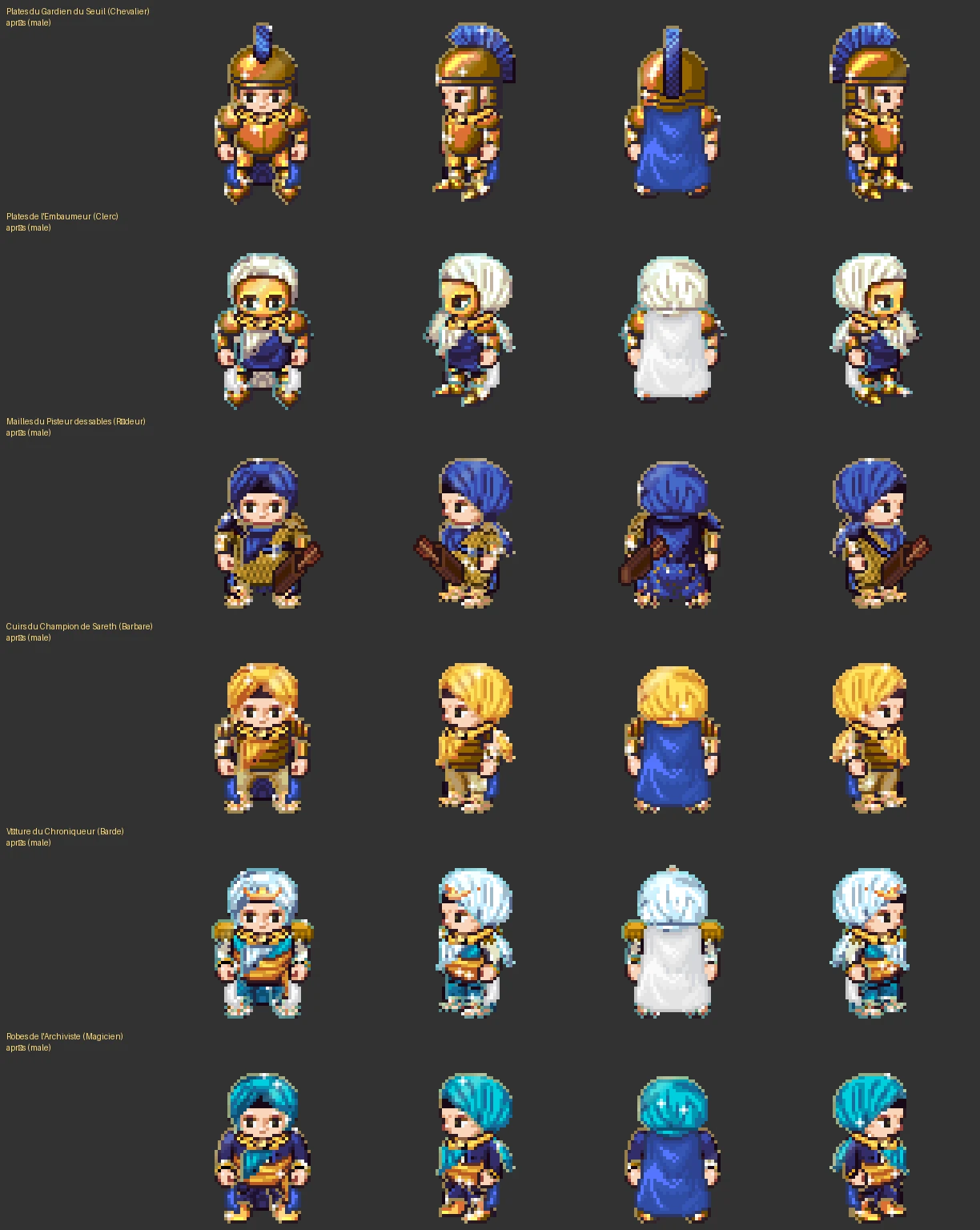
The Monastery of the Eighth Bell's six sets used dark, earthy color ramps matching the place. The result read as “brown monk.” We chose the opposite: these are treasures, so they should shine. Noble metal, saturated fabrics and a sign of each office.
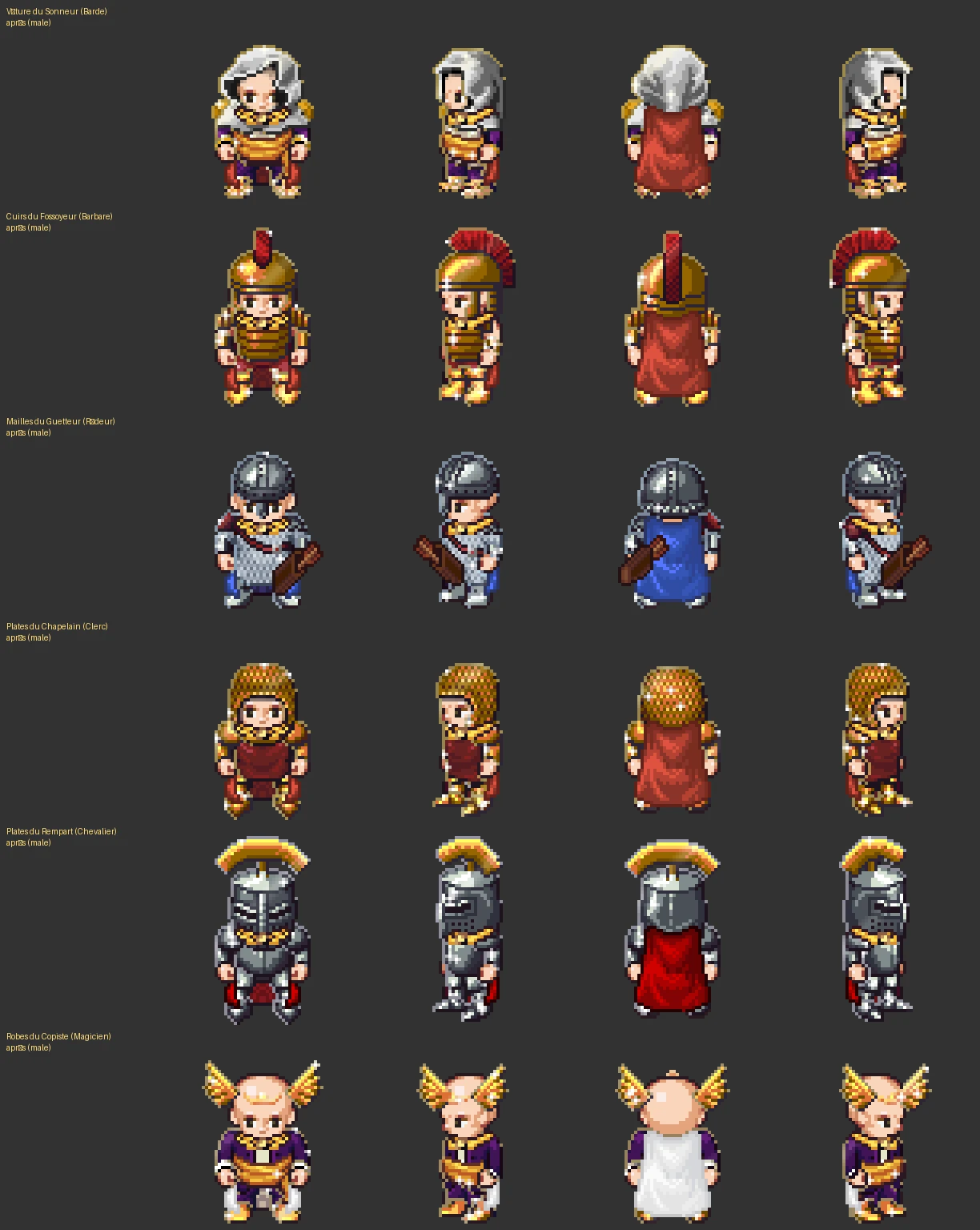
The direction was approved piece by piece, with several rejected along the way. The Gravedigger in an executioner's hood and gravedigger's apron: “not attractive at all.” It became a golden legion champion with a red mane. The Cleric wore a crown over its coif: “too much.” The Copyist keeps golden wings, but its tiara reveals the hair, requiring a client rule change: previously, every head item hid the hair.
The Count, finally by class
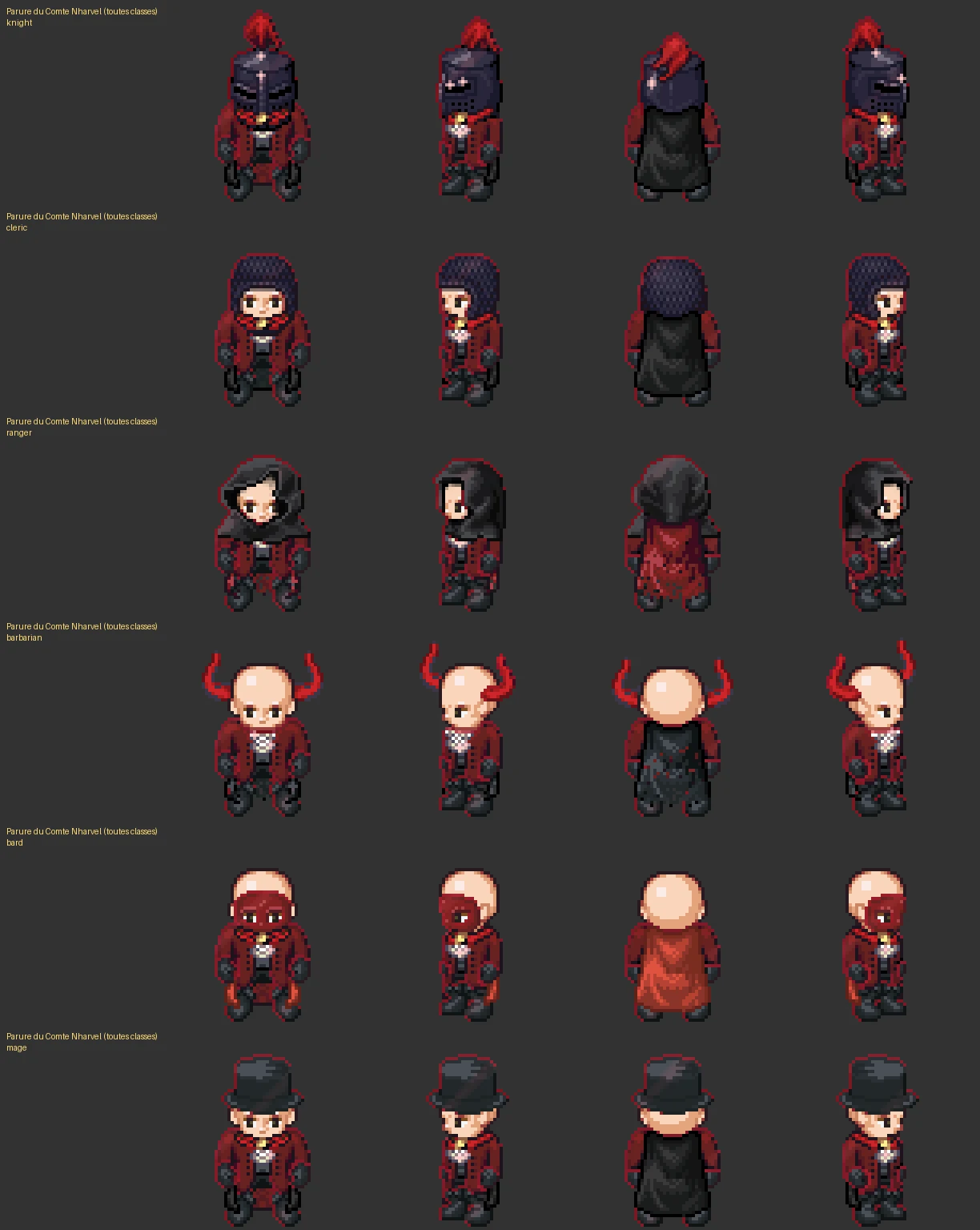
Count Nharvel's Regalia predated the class system: a single leather set open to all, making Clerics roll for leather they do not wear. It now has six versions, each in its class's heaviest armor family, with a shared body (burgundy frock coat and jabot, taloned gloves, black cape lined in red) and a class-specific headpiece. Existing pieces remain with their owners but no longer drop. At six pieces, each defeated enemy restores 8% health.
The Lower City had a boss and no loot
The pyramid raid led to Sareth the Unchanged, who dropped nothing. It now has what the Monastery has: six class sets, a six-piece gameplay trait, two named floor guardians with trophies, and a calibrated material budget.
For the budget, we counted actual monsters across the four maps instead of estimating: 111 enemies per run, against 167 in the Monastery. Royal mummies each dropped a mithril shard at 6%, roughly two shards per player before reaching the king, three times what a run should yield. They now drop vein hearts, and Sareth guarantees the shard. A complete run is worth one exceptional mithril piece.
What remains open
Two things remain unresolved, and we prefer to say so. A player who already owns a set piece can roll it again: the roll does not check ownership, and a duplicate bound piece is useless. We know how we want to handle this: recycling into crafting materials unavailable elsewhere, one per raid and one per boss, to combine. That is another project.
The other point fits into a checkbox shipped with this version: the guild crest covers the cape, so it also covered the Cleric's white cape and the Bard's lavender cape. Everyone can now choose whether to display it. The cape belongs to its wearer; the crest belongs to the guild.